Designing and Building a Unified Platform for the RV Park Industry

Introduction

RVLBO (RV Lots By Owner) is a full-scale digital platform designed and developed by We Make Platforms (WMP) to address the operational and commercial complexity of modern RV parks. Unlike traditional booking tools or property management software, RVLBO was conceived as an end-to-end ecosystem; one that connects renters, park operators, lot owners, service staff, and administrators within a single, coherent system.

The platform was not commissioned by a single client. Instead, RVLBO was built as a product in its own right, based on a clear market gap:
The absence of a purpose-built, role-aware platform that reflects how RV parks actually function in the
real world.

Industry Context and Problem Space

The RV park industry sits at the intersection of hospitality, real estate, and long-term property management. Yet most digital tools available to park operators focus narrowly on one aspect of the business, typically bookings, while ignoring the broader operational reality.

In practice, RV parks deal with:
• Mixed inventory (short-term rentals and lots for sale)
• Multiple stakeholder types with overlapping responsibilities
• Ongoing coordination between front-desk operations and on-site staff
• Compliance, billing, and long-term park governance

These needs are often handled through a patchwork of spreadsheets, messaging apps, and generic property tools that were never designed for this domain.

WMP identified that the real challenge was not building “another booking platform,” but designing a system of record for RV parks—one that could support discovery, transactions, operations, and oversight without fragmentation.

Product Vision

From the outset, RVLBO was designed as a platform, not an app.

The guiding principles were:
• One shared data model across all roles
• Clear separation between public-facing experiences and internal operations
• Mobile-first workflows for on-the-ground staff
• Scalable governance for platform administrators
• Flexibility to support both rentals and sales

Rather than optimizing for a single user journey, RVLBO was built to support an entire operating environment, with each interface exposing only what is relevant to the person using it.

Platform Architecture and Role Awareness

A core architectural decision was to make RVLBO deeply role-aware. Every interaction with the platform is shaped by context; who the user is, what park they belong to, and what responsibilities they hold.

This allows the same underlying system to power:
• Consumer-facing discovery and booking
• Operational dashboards for park and lot owners
• Calendar-driven reservation management
• Task-based mobile workflows for housekeeping and maintenance
• Centralized administration and governance at the platform level

Crucially, this is achieved without duplicating logic or data. All activity,bookings, messages, tasks, invoices, flows through a single platform backbone.

Renter Experience: Discovery Without Friction

For renters, RVLBO provides a familiar but purpose-built experience. Users can search for RV parks by location, availability, and compatibility with their RV type, explore detailed park and lot pages, and manage bookings through both web and mobile interfaces.

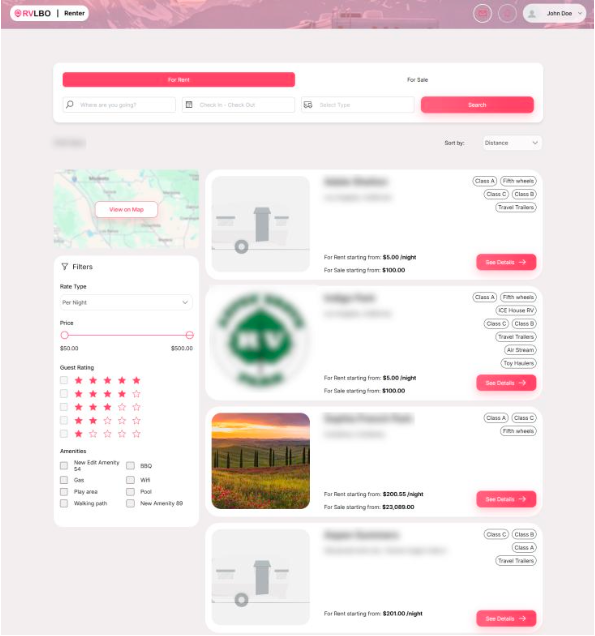
A search-driven renter experience designed for clarity, flexibility, and confidence—combining availability, pricing, RV compatibility, and map-based discovery in a single flow.

The experience balances simplicity with transparency. Pricing, amenities, availability, and park rules are clearly surfaced, while features such as favorites, messaging, and RV profiles reduce friction for repeat users and long-term stays.

Importantly, renter interactions are not isolated from operations. Every booking feeds directly into park schedules, staff workflows, and reporting; eliminating the disconnect common in traditional systems.

Park and Inventory Modeling

One of RVLBO’s key strengths is how it models parks and lots as distinct but connected entities. Parks are treated as operational units with their own identity, configuration, and permissions. Each park maintains structured data around location, amenities, RV compatibility, operating rules, and branding.

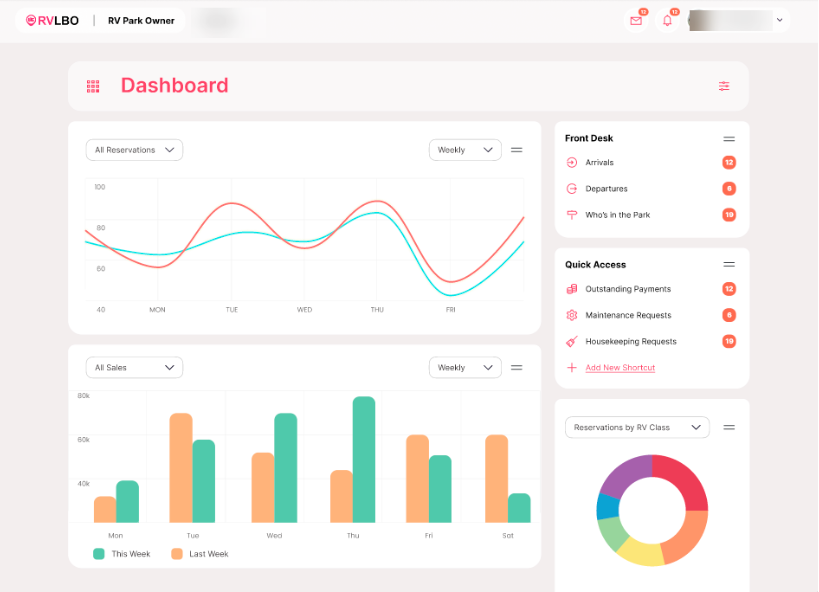
A centralized operational dashboard that gives park owners real-time visibility into reservations, revenue performance, occupancy, and on-ground activity across their inventory.

Within each park, individual lots are managed as discrete assets. This allows for granular control over availability, pricing, and usage, while still rolling up into park-level reporting and oversight.

This structure enables RVLBO to support a wide range of park types, from small independent sites to larger, multi-park operations.

Booking & Reservation Management

On the operational side, RVLBO provides flexible reservation management tools that adapt to different working styles.
Visual calendar views allow operators to understand occupancy and availability at a glance, while detailed list views support transactional management and reporting. Filters and sorting options make it easy to manage high volumes of reservations across dates, lots, and parks.

For multi-park stakeholders, the ability to switch between parks without leaving the workflow is critical. RVLBO was designed to support this natively, rather than as an afterthought.

Messaging as Infrastructure

Communication is often where operational systems break down. RVLBO addresses this by embedding messaging directly into the platform, rather than treating it as an external add-on.

Messages are contextual, tied to specific parks, lots, and bookings, ensuring that conversations remain relevant and traceable. This reduces reliance on external channels and helps park operators maintain clear records of interactions with renters and stakeholders.

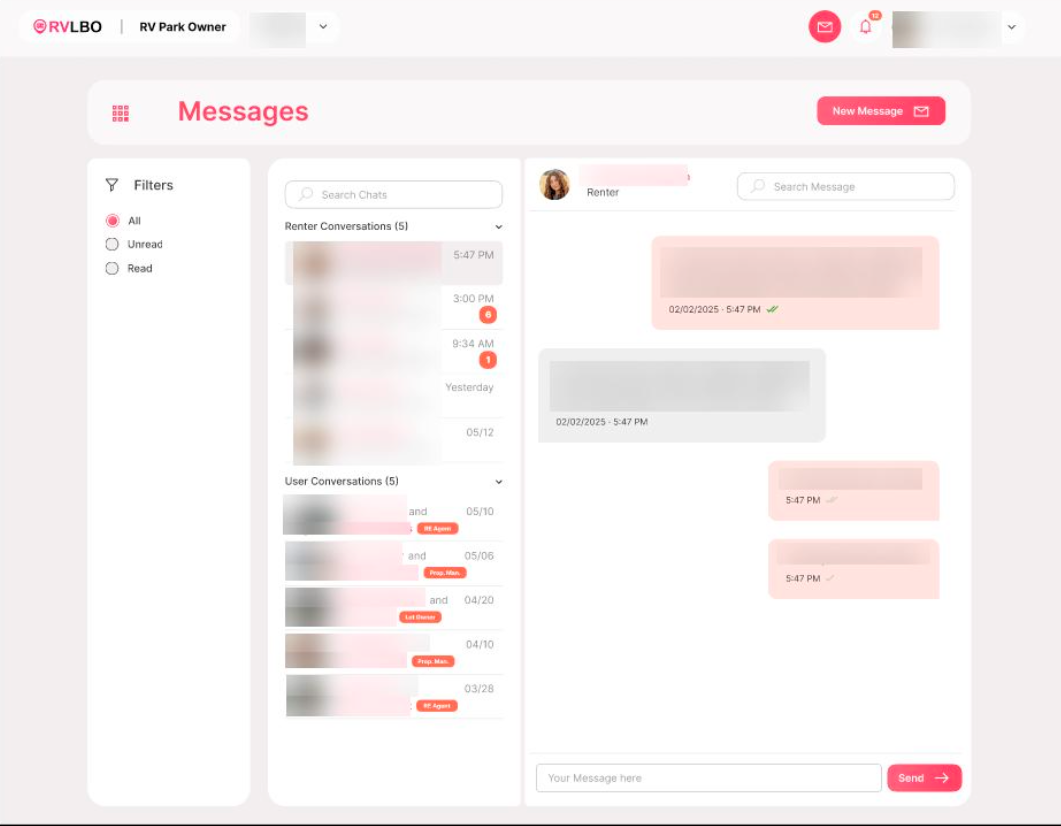
A built-in, role-aware messaging layer that connects renters, park owners, and operators within the context of bookings, lots, and parks—without leaving the platform.

Mobile-First Operations: Housekeeping and Maintenance

RVLBO extends beyond desk-based workflows through dedicated mobile applications for housekeeping and maintenance teams.

These apps are designed around real-world operational rhythms:
• Daily task lists driven by check-ins and check-outs
• Clear status indicators for urgency and readiness
• Simple start, pause, and completion flows
• Time tracking and notes for accountability
• Photo uploads for verification
• Built-in map views to locate lots quickly on large properties

By connecting operational tasks directly to booking data, RVLBO ensures that on-site work is always aligned with guest activity.

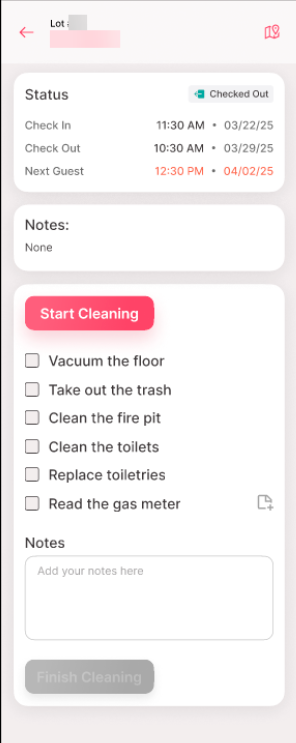
Mobile-first task execution with real-time status, timestamps, and standardized checklists—designed to keep turnovers predictable and auditable.

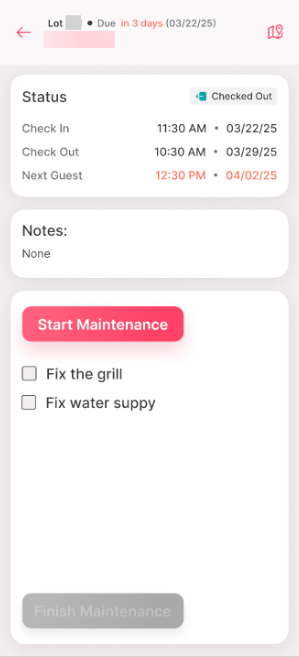
Maintenance tasks are tied to lot status and booking timelines, enabling teams to prioritize, execute, and close issues directly from mobile.

Administration, Governance and Scale

At the platform level, RVLBO includes a comprehensive Super Admin interface that supports governance, compliance, and growth.

Administrators can review and approve new parks, configure permissions and user types, manage staff access, and control global settings such as park types, RV classifications, and amenities.

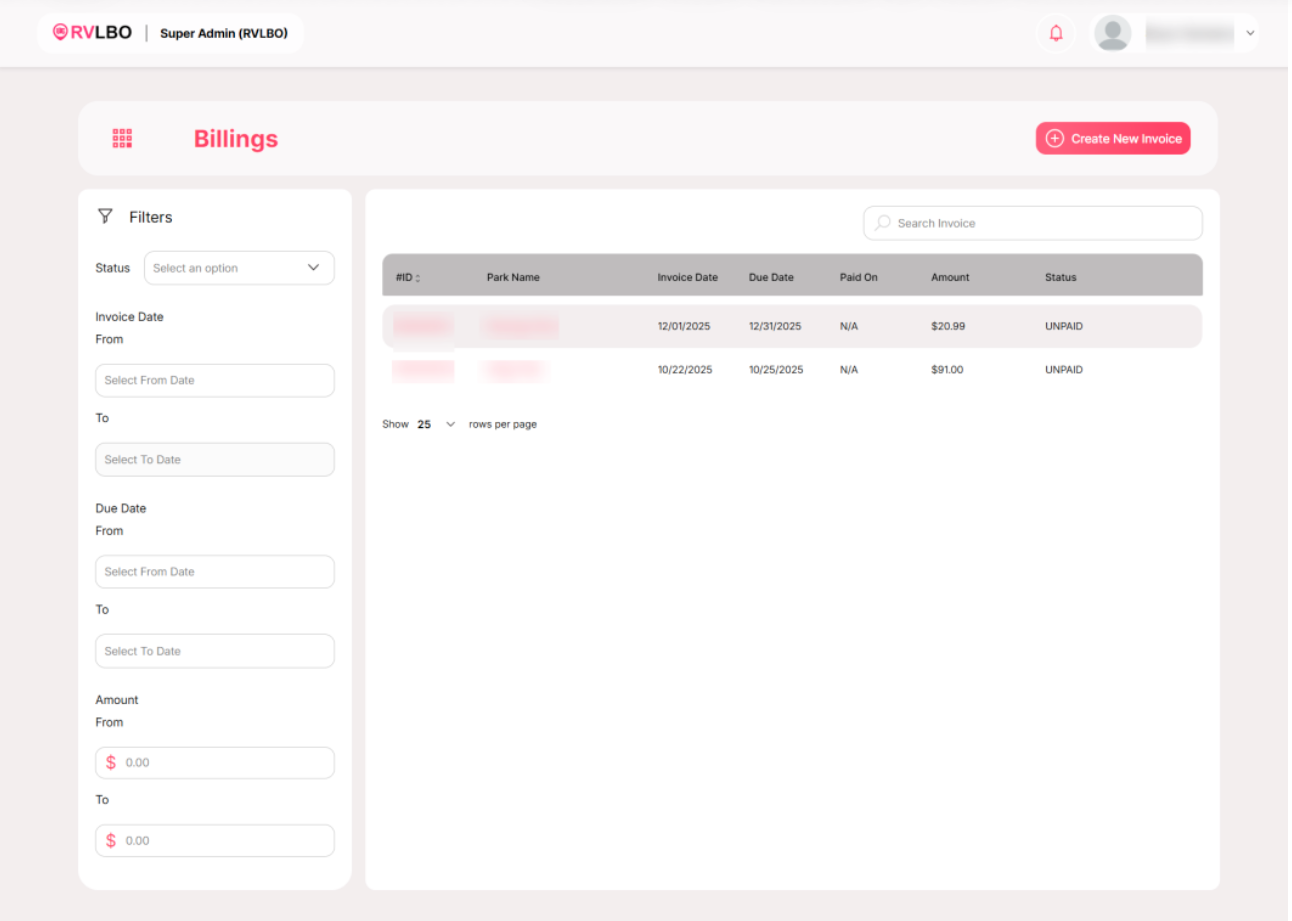
A built-in billing system allows the platform to generate and manage invoices, track payment status, and support monetization models aligned with park participation.

The inclusion of configurable staff permission profiles ensures that access can be tightly controlled without sacrificing flexibility, an essential requirement for scaling beyond early adopters.

A unified billing layer that gives administrators full control over invoicing, due dates, and payment status across the ecosystem.

Design and UX Considerations

Throughout RVLBO, WMP prioritized clarity and consistency over visual novelty. The interface language is clean, restrained, and functional, allowing users to focus on their tasks without cognitive overload.

Navigation patterns are consistent across roles, while layouts adapt to surface only what is relevant in each context. This reduces training overhead and allows users to move between different parts of the system intuitively.

The result is a platform that feels approachable despite its depth.

Outcome and Impact

RVLBO demonstrates how a fragmented industry can be unified through thoughtful platform design.

By bringing discovery, booking, operations, and governance into a single system, RVLBO reduces operational friction, improves visibility, and creates a foundation for scalable growth.

For WMP, RVLBO serves as a clear example of the studio’s ability to:

• Understand complex, real-world industries
• Design systems around workflows, not features
• Build multi-role SaaS platforms from the ground up
• Balance user experience with operational rigor
• Think beyond early prototypes and design for long-term product sustainability

Why This Matters

RVLBO is not just a product; it is proof of platform thinking in action.

It shows how We Make Platforms approaches software design when the goal is not simply to ship functionality, but to create systems that can evolve, scale, and sustain real businesses.

For organizations looking to build products that sit at the center of complex ecosystems, RVLBO stands as a compelling example of what’s possible when strategy, design, and engineering are aligned.

Looking to Build Your Online Platform?

Contact us today to discuss how we can upgrade your digital presence, improve user experience, and ensure long-term scalability