Because the concept originated from deep industry involvement, the challenge was not identifying whether a problem existed, but translating years of operational insight into a scalable digital platform.
While general-purpose professional networks and job boards serve broad audiences, they are not optimized for industries with specialized workflows, certifications, and operational realities. For professionals within the marine sector, searching for roles on platforms such as LinkedIn, Indeed, or Monster often yields hundreds, or even thousands, of listings. But only a small fraction of them are genuinely relevant to marine work. Valuable opportunities are frequently lost in noise.
The challenge is mirrored on the employer side. When marine companies post highly specialized roles on general job boards, those listings compete with unrelated jobs across dozens of industries. As a result, marine-specific roles suffer from reduced visibility, attract unqualified applicants, and deliver poor value relative to cost.
Having spent over 15 years working within the marine industry, primarily in the recreational space, the owner of WMP experienced these inefficiencies firsthand. The lack of a dedicated, industry-focused digital space made it difficult to communicate, recruit, and network effectively within the marine community.
Beyond recruitment noise, the marine sector also faces broader structural challenges, including:
- Highly specialized job roles requiring certifications and domain knowledge
- Strong demand for operational, offshore, and technical professionals
- Limited global visibility for marine-focused companies
- Fragmented industry news and inconsistent reporting standards
- Inefficient recruitment workflows and limited trust signals
The goal was not to build another job board.
Instead, the platform needed to function as a vertical social and recruitment ecosystem, one where:
- Marine companies could publish verified, industry-relevant news
- Recruiters could manage high-volume hiring without dilution
- Job seekers could discover meaningful opportunities in context
- Platform operators could maintain quality, safety, and consistency
Equally important was the need for a robust Super Admin backend, ensuring that all users, content, and activity aligned with the professional standards expected within the global marine industry.
WMP’s Approach: From Industry Insight to a Purpose-Built Marine Platform
As both the platform builder and the originating stakeholder, WMP approached the Marine Industry
Network with a unique advantage: Deep, first-hand domain experience paired with full technical ownership.
With over 15 years of direct involvement in the marine industry, particularly across the recreational, retail, manufacturing, and service sectors, WMP’s founder had firsthand exposure to the communication, networking, and recruitment gaps that existing tools failed to address. This insider perspective shaped the platform from its earliest conceptual stages.
Rather than adapting an off-the-shelf CMS or a generic recruitment system, WMP designed and developed MIN from the ground up, embedding marine-specific logic directly into the platform’s architecture, workflows, and permissions model. This dual perspective, industry insider and platform builder, guided every design and technical decision.
A Unified Marine Industry Ecosystem
WMP implemented a fully customized product development strategy built around four foundational pillars:
1. Role-Based Workflows
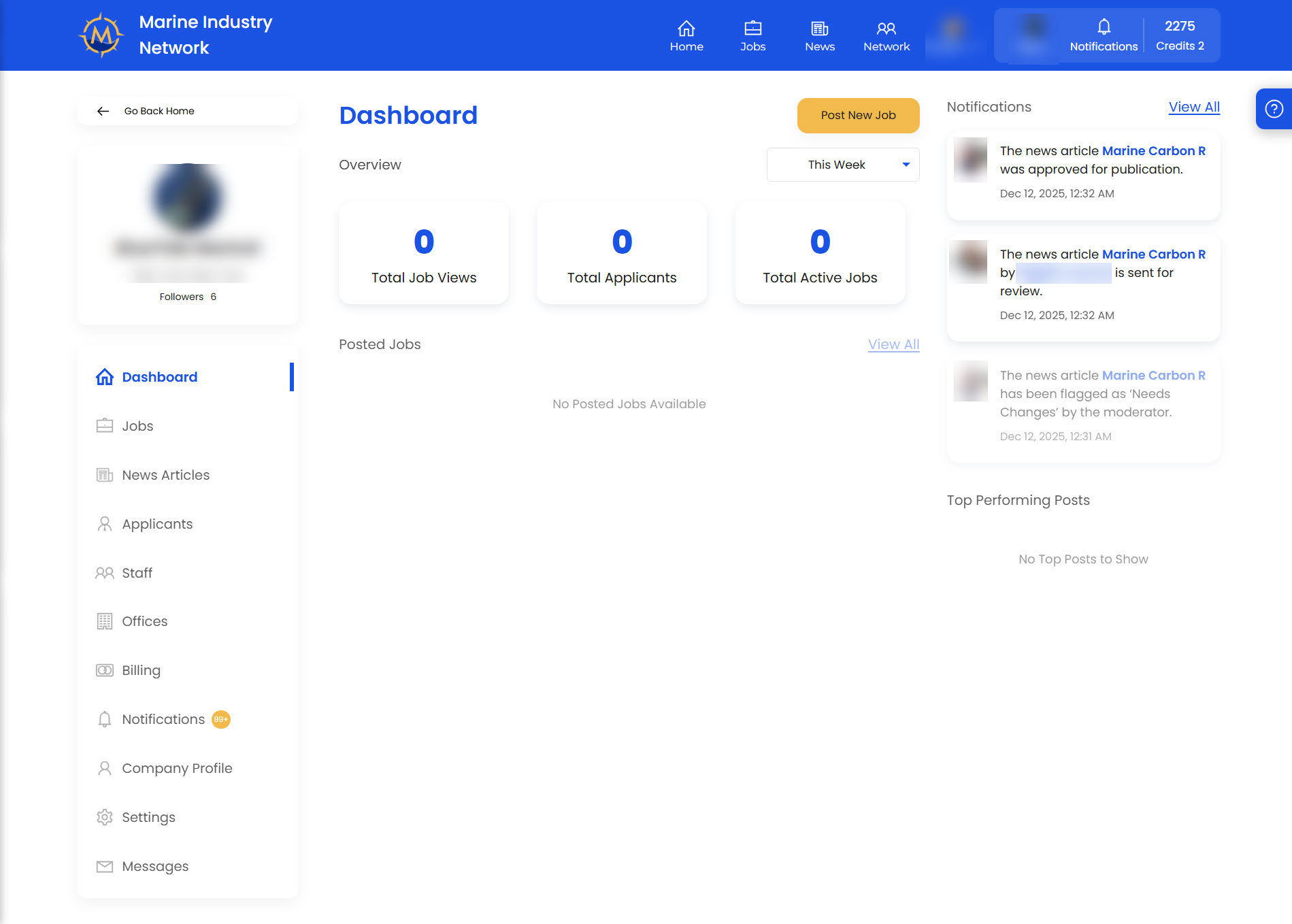
Each user group, Super Admins, Companies, Recruiters, and Job Seekers, operates within a tailored environment. Personalized dashboards and permission-based access ensure users interact only with the features relevant to their role.
2. Moderated Content Pipeline
All job posts and news articles move through a structured approval process managed by Super Admins. This moderation layer maintains content quality, accuracy, and platform safety across the ecosystem.
3. Credit System for Controlled Engagement
Instead of monetizing access through direct purchases, MIN uses a non-purchasable credit system. Companies receive an initial credit allocation during their trial period, and actions such as posting jobs consume credits. By preventing credit purchases, the system discourages misuse and preserves platform integrity.
4. Vertical Specialization by Design
Every feature—from job categories and industry segments to news topics and professional profiles—is purpose-built for the marine sector. This vertical focus differentiates MIN from general-purpose professional platforms and ensures relevance across the industry.